








Anna George has worked in the legal world as well as the film and television industries. Her first novel, What Came Before, was shortlisted for the 2015 Ned Kelly and Sisters in Crime Best Debut Fiction awards, and was longlisted for the 2016 International Dublin Literary Award. She lives in Melbourne with her husband and two children. Tipping is her third book.
Today, Anna George is on the blog to answer some of our questions about Tipping. Read on …

Anna George (Photo by Say Heidi Photography)
Please tell us about your book, Tipping!
AG: Tipping is a dark comedy set at a local school when one overwhelmed mum reaches tipping point – thanks largely to her husband locking her, inadvertently, in the family car.
What was the inspiration behind this novel?
AG: Married life, raising my school-aged sons and gendered norms. All this led me to want to write about overwhelming family life, the enduring lot of men and women and what we might do to shake things up.
Early on in my thinking about Tipping, I came across a couple of news stories about incidents at boys’ private schools in Melbourne. In one instance, some of the boys created an offensive Instagram account using photographs of girls in the community. I live in an area where these boys and their families and school mates lived. I became interested in how the community around the boys and girls responded to what had happened online. Some people were outraged on behalf of the girls, some were defensive of the boys. Some parents articulated their position online and were trolled for it. The boys involved were ultimately expelled but not before the behaviour of some adults escalated. In another instance, a vice principal was fired for cutting a boy’s hair, as it failed to comply with the school’s uniform code. In this case, the community rallied behind the man and its activism led to a reprieve for the deputy head and he was given his job back; but the haircut revealed deeper issues at play at the school. Ultimately the relatively newer principal left.
Inspired by these events, I decided to use a sexting scandal as a springboard into a story about a mum who decides she’s had enough with the status quo – at home, at work and at her boys’ school.
Though this all sounds like serious stuff, it’s not in Tipping. I made a decision early on to mix up the tone with this book and make it lighter and more playful. I wanted to have fun with this material.
This novel is about ‘domestic activism’ – the kind of small work that parents can do that can eventually result in real community change. Why do you think it’s important to write about this in fiction?
AG: Liv’s decision to reset her family life and consciously pursue gender equality on the home front is what I think of as her domestic activism. She decides to make small changes to herself and her family’s way of doing things so that the division of labour at home is fairer. She also becomes more alive to the influence she and her husband Duncan have on their boys as role models. Her efforts at home then have an effect on her children and her husband. Quite early on, Liv takes her activism out of the house and to the boys’ school too.
It’s important for me to write about topics that I can sink my teeth into and travel with for a number of years. I need to care about what I write about. A few years ago, I found myself feeling overwhelmed both by my family life and by the seemingly intractable problems out there in the world… and then I read about the power of tweaks. Small changes which can be remarkably effective at creating bigger change. I found that idea so heartening and inspiring; so I married it with these other ideas about schools and scandals.
The school-parent-child relationship can be very tricky to handle – nobody wants to believe their child would be capable of doing bad things and often it’s the mums who have to shoulder the load of a child misbehaving at school. How did you approach this from a writer’s perspective?
AG: In Tipping, I left it up to the mums to shoulder this load. The mums are the face of the family at the school, generally. And the mums face off in the coffee shops when the children misbehave or clash. Mums are a diverse bunch and I wanted to explore how the different mums in Tipping reacted to their child’s behaviour. Duncan is also involved, of course. But my interest was mainly in the women.
You’ve mostly written thrillers before this – what made you want to write in a different genre this time around? How did the process of writing a contemporary novel compare to that of writing a thriller?
AG: Once I’d finished my second book, I was keen for a change. About then, I realised that writing psychological thrillers was accessing only a part of who I am as a writer and a person. I enjoy reading books containing light and shade and wit, and I decided to try to bring more humour to my writing. As a result, once I had the tone worked out in Tipping, I really enjoyed the writing process. The words came fairly easily and the writing flowed. This book is much longer than my first two, which were on the short side. I hope people can feel that I enjoyed writing the book – I let my hair down a bit. And I relished the opportunity to be playful and have a go at creating characters and moments that could be fun. Another big difference was how I wanted to leave readers feeling. With Tipping, I want to leave readers feeling uplifted and optimistic, inspired and even joyful.
‘I realised that writing psychological thrillers was accessing only a part of who I am as a writer and a person. I enjoy reading books containing light and shade and wit, and I decided to try to bring more humour to my writing.’
What was the hardest thing about writing this novel?
AG: Finding my way into the section where things start to change at Carmichael Grammar. It took me a while to work out how to effect change at Carmichael without that classic teacher as change agent through their actual direct teaching and relationships with the students. I didn’t want to write one of those inspiring teacher stories, where the force of the teacher’s personality and connection with the students are what make the difference. Here the subtle interventions put in place by Dr Cato are the key drivers of the change. It’s more about what can be done, rather than who does it, though Dr Cato’s charisma helps. I think of these changes as lateral, or indirect, which makes them more interesting to me.
Once I married the thinking around tweaks with changing the dynamic at the school the middle section clicked into place. My research around behavioural design gave me this key link. This idea that you can change people’s behaviour without needing to directly get every person on board – that you can do it by changing their environment, or their work and learning processes – really excited me.
What is the best piece of writing advice you have ever received?
AG: Another author once told me, before I was published, to ‘Back myself’. This is the simplest and hardest piece of advice I’ve ever had. But it is absolutely fundamental in a writer’s life and I still think about it.
What was the last book you read and loved?
AG: Girl, Woman, Other by Bernardine Evaristo was excellent. Hamnet by Maggie O’Farrell was too. But honestly love doesn’t strike me often and when it does it’s deep. So for real and unconditional love I’d have to go for Olive, Again. The Olive books by Elizabeth Strout would have to be my all-time favourite books – for their wit, empathy and wisdom. And for Olive herself. She’s a masterpiece.
What do you hope readers will discover in Tipping?
AG: I hope people will discover a way to see their own worlds through fresh eyes, as the characters in Tipping come to do. I hope they enjoy the playful tone of this novel and are engaged by the ideas I’ve popped in it.
And finally, what’s up next for you?
AG: There’s always another book, for me, and I’m thinking about Book Number Four now. I’m hoping to stay in this lighter, more playful space.
Thanks Anna!
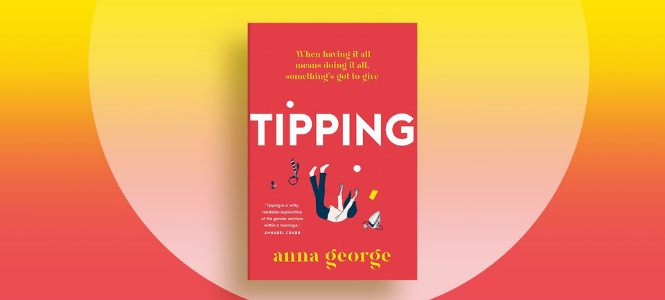
—Tipping by Anna George (Penguin Books Australia) is out now.
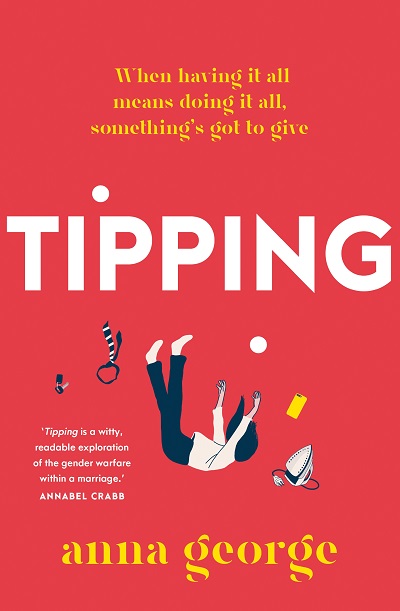
Tipping
Liv Winsome, working mother of three sons, wife to decent if distracted Duncan, is overwhelmed. And losing her hair. Her doctor has told her she needs to slow down, do less. Focus on what’s important.
After Jai, one of her fourteen-year-old twins, is involved in a sexting scandal, Liv realises things need to change, and fast. Inspired by the pop-psychology books she devours, she writes a nine-page list of everything she does to keep the family afloat, and she delegates. She lets her boys’ conservative school know it has some work to do, too...

 The Ned Kelly Awards 2018 – Shortlists
  Ned Kelly Awards 2018 Longlists Announced
Comments
No comments