








Have you ever wondered if time travel is actually possible? Or where the Australian accent came from? Or what it feels like to have dementia? If you’re an inquisitive person who likes to understand how things came to be the way they are, Explain That is a collection of thought-provoking explainers from The Age and The Sydney Morning Herald that will have you covered.
Today, we’re featuring an extract from Explain That written by Melanie Kembrey that’s all about the murky world of art fakes and forgeries. Read on …
 How do you fake a masterpiece?
It’s difficult to get away with faking an artwork but not impossible. How many fakes are out there, and how are they unmasked?
by Melanie Kembrey
I’ve always wanted to own a Picasso. A hand-signed etching with stamps of authenticity from the Musée d’Orsay in Paris and Christie’s New York would do the trick. As luck would have it, there’s one for sale online. It costs $10,000. The listing says it’s a rare opportunity. I’d either be a fool if I did or a fool if I didn’t – and I can’t quite figure out which kind of fool I’d rather be. So I run my potential acquisition by one of the world’s leading experts in art crime.
‘I would suggest,’ Professor Duncan Chappell replies, ‘that investing in it would be a swift way to lose the family silver.’
There are a couple of giveaways. The etching would have been sent from south Sydney, which is ‘hardly the sort of spot you would expect a stray Picasso print to be sourced from’. Even more troubling, according to Chappell, is that the Musée d’Orsay and Christie’s do not usually provide certificates of authenticity.
My Picasso was a con. But while the etching was fake, the issue of art fraud is real. Chappell, who co-edited the Palgrave Handbook on Art Crime and is a former director of the Australian Institute of Criminology, says a conservative estimate is that 10 per cent of artworks, in Australia and internationally, are of questionable origin. Art historian Thomas Hoving, the former director of New York’s Metropolitan Museum of Art, claimed that up to 40 per cent of thousands of works he examined could be considered fakes, while Sharon Flescher, the executive director of the International Foundation of Art Research, has reported that close to 80 per cent of works submitted to the organisation were not by the attributed artist.
’10 per cent of artworks, in Australia and internationally, are of questionable origin.’
There are plenty of whispers, anecdotes and unofficial blacklists about forged works – in Australia the market is a small pond, after all – but the cases that do gain public notoriety usually involve big names, big galleries, big coin and big courts.
For artists, they can be a huge drain on money, time and spirit. The late Robert Dickerson, one of Australia’s most famous figurative painters, went to court to have fakes of his work destroyed. He won, but his son Sam says, ‘He found it depressing and deflating. It just distressed my dad so much.’
So what does it take to fake a work of art? And what happens if you get caught?
What is a fake?
Art fraud is one of three key types of art crime, alongside art theft and cultural heritage offences, including antiquities looted from conflict sites. All three hinge on one word: provenance. From the French provenir, meaning to come from, provenance is an artwork’s biography, including authorship and ownership. It can include receipts of purchase and sales, exhibition catalogues, notes and photographs of works in progress. Chappell says the terrain of art fraud is ‘cluttered with meanings that may cause occasional confusion’ with terms including copy, forgery and fake used loosely. But they are distinct in practice.
Copying an artwork, or painting in the style of an artist, is not a crime. Artists have long honed their craft by copying the masters. There are dozens of imitations of Leonardo da Vinci’s Mona Lisa, including the Prado Mona Lisa, which is believed to have been painted by one of his apprentices at the same time and in the same workshop as the version that hangs in the Louvre. Chappell says under English common law the term ‘forgery’ does not apply to works of art but to the forging of documents or writing – and it is the false signature added to an artwork that qualifies as the forgery.
The term fake, however, ‘implies both the work in question is not authentic, and that it has been intentionally produced to deceive’, says Chappell. A fake involves a physical element (the painting that is not what it appears to be) and the mental element (the intention to deceive). Faking an artwork usually falls under the category of fraud rather than forgery, although selling a fraudulent artwork might involve forgery including doctoring documents of authenticity.
Yet in common parlance, those who create fake works are often referred to as forgers. Biographies of Michelangelo suggest the great Italian artist dabbled in fakery early in his career, doctoring a statue to appear ancient and selling it to a cardinal who collected Roman antiquities. Professor Alexander Nagel, from New York University’s Institute of Fine Arts, has highlighted how the concept of forgery developed parallel to the art market in the West, around 1500, and before then originals and copies were happily interchangeable. Since then, artists including Andy Warhol have mocked the concept of individual authorship, blurring the fake and the genuine in their practices, and making authentication of their works challenging.
What does faking a masterpiece involve?
A good fake requires artistic talent and expert knowledge. The British artist John Myatt perpetrated one of the biggest art frauds of the twentieth century by faking works by Henri Matisse and other major artists – which were sold by his co-conspirator John Drewe, who forged documents to convince buyers they were genuine – before they were both imprisoned in England in 1999. Myatt later told The Guardian that he wanted to be hypnotised by the artist whose work he was faking. ‘I like to know everything – where he was, what he was doing, what his relationship was like with his wife when he was painting.’ Fraudsters such as Myatt replicate the nuance of an artist’s practice – style, signature, the application of brushstrokes – and source materials and frames from the correct time period. German fraudster Wolfgang Beltracchi made many millions of dollars before he was famously caught out using titanium white paint in a Heinrich Campendonk knock-off meant to be from 1914 – the pigment did not exist at the time.
‘A good fake requires artistic talent and expert knowledge.’
Some fraudsters can seek to avoid attracting attention by selling their work for modest prices. They will look to copy smaller pieces by lesser-known artists prolific in their output and liberal in the distribution of their art, or by artists whose biographical details are sketchy or disrupted by illness or a world war – because this leaves room to concoct a convincing explanation for why they can’t prove a work is genuine. It’s also easier if the artist is not living, if their estate is not closely guarded by relatives and if there is no catalogue raisonné, a document detailing all known works by an artist.
That’s not to say fraudsters don’t go big. The art world was rocked by false works purporting to be by major abstract expressionists being sold as real by Manhattan gallery Knoedler and Company, which closed in 2011 ahead of major lawsuits from collectors who had bought the pieces. The $80 million fraud, the subject of a Netflix documentary Made You Look: A True Story About Fake Art, saw dealer Glafira Rosales sell more than 60 works to the gallery, claiming she was given them by a collector called Mr X. The gallery, one of the oldest in America, sold the paintings for more than 15 years, turning a significant profit. The painter turned out to be Chinese immigrant Pei-Shen Qian, who made the fakes in his Queens garage, which when raided by the FBI contained ‘books on abstract expressionist artists and their techniques; auction catalogues containing works by famous American abstract expressionist artists; paints, brushes, canvases and other materials, including an envelope of old nails marked “Mark Rothko”.’ Rosales pleaded guilty to multiple charges but Qian has maintained he was the victim of a ‘very big misunderstanding’ – he claims he never intended them to be sold as the real thing, and never received more than $7000 for a painting. He was indicted in the US on charges of wire fraud, conspiracy to commit wire fraud and lying to the FBI in relation to the fraud, but now lives in China. ‘I made a knife to cut fruit,’ he told Bloomberg News. ‘But if others use it to kill, blaming me is unfair.’
—Explain That, edited by Felicity Lewis and published by Penguin Books Australia, is out now.

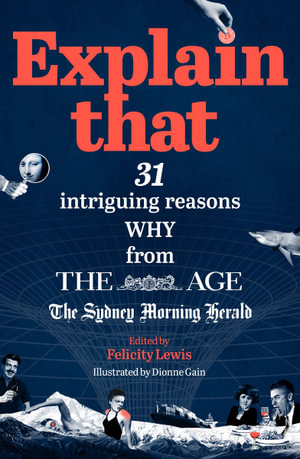
Explain That
31 intriguing reasons why from The Age and The Sydney Morning Herald
From the nation's most trusted news outlets comes an entertaining and authoritative look at the world around us.
Have you ever wondered if time travel is actually possible? Or where the Australian accent came from? Or what it feels like to have dementia? If you’re an inquisitive person who likes to understand how things came to be the way they are, this collection of thought-provoking explainers from The Age and The Sydney Morning Herald has got you covered...

 REVIEW: Framed by John M. Green
  Look inside Disturbed Home – a celebration of the work of Ian Strange
  Read a Q&A with Mary Beard! | Twelve Caesars
Comments
No comments