








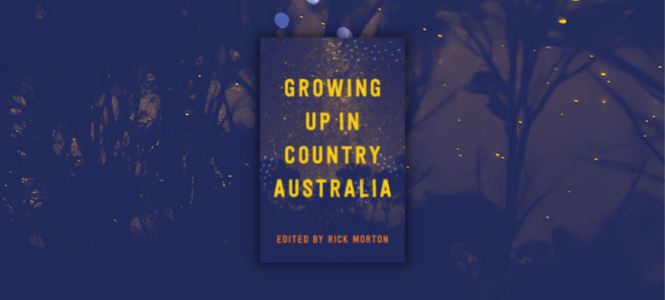
Black Inc. Books’ Growing Up series has a brand new entry: Growing Up in Country Australia, edited by Rick Morton! With nearly forty stories by established and emerging authors from a wide range of backgrounds – including First Nations and new migrants – Growing Up in Country Australia is a unique and revealing snapshot of rural life.
Read an extract from Growing Up in Country Australia written by writer and teacher Fiona White below!
A New Home
by Fiona White
The Australia of my early childhood was a hard-baked land from which I came and went. With itchy-footed Australian parents, my brothers (first there was one, then two, then three) and I saw Australia as a holiday destination. A land with two gentle grandfathers and a beautifully spoken, worldly aunt who sent me wonderful books.
We returned to Australia every three years; that was Dad’s promise to Mum when they left to live in New Zealand. We will always come home to see our families, and we will stay long enough that you are happy to leave again.
But my grandfathers grew frail, and the land of eucalypts and wide-stretching skies called to my mother, an artist, in a way that no travelling adventures could silence.
I was thirteen when Mum told Dad, ‘If we don’t go home now, our fathers will be gone and our children will settle in foreign lands.’
It was as simple and as complicated as that. They sold our two-storey house on a North Island peninsula between Eastern Beach and Bucklands Beach. They sold the cars with their lacework of rust etched by the briny sea air. We rehomed the guinea pigs and the loud white duck that lived in our murky paddling pool beneath the fruit trees.
‘The dogs will come, of course,’ Dad said, ‘and Mum’s Siamese cats.’ Then he levelled me with his solemn blue gaze. ‘But you’ll have to sell your horse.’
Sell my horse. This was no ordinary horse. This was Nimbus – I’d fallen in love with him at the riding school where I volunteered. I’d been the only one who could catch him and get his bridle on. Mrs Oates, the owner of the riding school (yes, that was her real name), said he was probably ear-twitched when they broke him in.
‘The trainer loops a thin weave of string around the horse’s ear to force them to behave,’ she told me.
A fierce ache grew in my heart and I vowed I would give Nimbus all the love and protection he deserved.
‘Horses aren’t like dogs,’ Dad said. ‘You don’t bond with them the same way, and besides, it’d cost thousands to fly him across. I’ve already checked.’
Dad was an economist and a practical man.
I wrote poems. I cried. I advertised Nimbus for sale, like my parents told me to. People came. They saw a wild, naughty pony no-one could catch. I saw one of my greatest loves. Eventually (due, I suspect, to Mum’s quiet but relentless campaigning) one of my grandfathers came to the rescue. He’d found out that ship fares were much cheaper than planes. He got out his cheque book and paid half of the $900 fee to transport that $400 pony to Australia, while Mum and Dad paid the other half.
‘This was no ordinary horse. This was Nimbus – I’d fallen in love with him at the riding school where I volunteered. I’d been the only one who could catch him and get his bridle on.’
Nimbus arrived on the Melbourne docks in May 1981, narrowly beating the major wharf strikes that left animals and shipping containers stuck at sea for weeks on end. He travelled there in a wooden box with an expensive broodmare on either side. It took three days for his ship to cross the ocean. Three days during which I woke every morning sick with dread that he’d somehow been put onto a livestock version of the Titanic.
Nimbus always made a ridiculous song and dance about everything. I’d lost count of the number of gymkhanas we’d missed or turned up too late because he wouldn’t get in the hired float, no matter how many buckets of food, threats or spiky brooms I used to persuade him.
That horse transport mob, though, took no prisoners. Nimbus was whisked out of the crate and onto a fancy blue truck before he had time to blink. They drove him to our new home in Macedon, bouncing up the narrow gravel driveway, gum-tree branches scraping the truck roof while Nimbus shifted and stamped inside. What was this nonsense? What had his crazy owner done this time?
He came off the truck, head high and eyes white-rimmed, snorted at me and the bracken-dotted paddock, flaring his nostrils at this ancient land abundant with kangaroos, koalas and snakes.
We went for long walks. I had started a new school, and I told Nimbus how hard it was to make friends when everyone had known each other forever and no-one needed to know anyone new. I explained to Nimbus that it turned out I had an accent and all the kids thought I sounded funny. I leaned into his solid shoulder and told him I wished we could go home. He sighed heavily, as if he wished we could, too.
Nimbus and I spent our weekends exploring. We galloped the bush tracks beside the railway line; he froze in horror the first time a long red rattler trundled past, kids’ faces pressed to the windows.
We met a snake and there was a millisecond when the three of us – Nimbus, me and the brown snake with tiny, dark eyes – stared at each other in equal shock. The snake may have met a horse or two in its time, but for Nimbus the existence of this slithery creature must have left him wondering how long the list of exotic creatures in this new land was going to get.
We discovered the pine forest and swam in the dam on hot summer nights. Frogs and crickets sang songs while kookaburras guffawed and cockatoos wheeled and screamed. I told Nimbus about the boys I liked and he listened and sighed and then frowned when I made him wear a fly fringe. The flies in New Zealand were not nearly this persistent and rude, I’m sure he thought.
He adapted amazingly well, my little kiwi horse, but then came 1983, a ferocious summer on the back of years of drought. Nimbus was in the neighbour’s paddock the night the Ash Wednesday fires roared through the ranges. He’d jumped over there to eat their grass – his paddock had so little.
The fire sounded like a freight train. It lit up the sky. The wind threw sparks and ash like bombs. He was trapped in that paddock. Inexperienced and unprepared, dressed in a tank top, thongs and a miniskirt, I ran to Nimbus, vaulted onto his back and tried to make him jump the fence. Fire inhaled the forest behind us. Nimbus was too spooked to listen to reason. He couldn’t see the fence, couldn’t understand my frantic pleas. One of my brothers came down and demanded I leave.
‘We have to evacuate,’ he said. ‘Everyone is in the car – even the cats and the cockatoo.’
Evacuate meant going without Nimbus. It meant leaving him there in that paddock that was already starting to burn. I dismounted and ran, sobbing, smoke thick and acrid in my eyes. There would be someone – police, firefighters – who could come and save him, surely?
This horse, the greatest love of my childhood, I left him. I let myself be stuffed in the back of the old, grey Falcon and be driven away.
Our neighbour’s house was already burning as we inched our way down the dirt road, through smoke so dense it was like a solid beast.
‘He was my first friend. My great friend. Head-shy and difficult he might have been, but there was something when we met that ignited in my heart and the flame never went out.’
We spent the night in our car in the nearby township of Gisborne. We were given food from the supermarket shelves, even though we had no money with us.
Next morning, as the roads reopened, we drove home to a razed world. Where there had once stood houses now stood shells. Animals lay, black and bloated, in bare paddocks. A mantra had played in my head all night, over and over until it was knitted into my cells and looped around my heart. Please give us a miracle. Please let him survive.
We passed our neighbour’s ravaged block and the crumpled mess of their home. Drove up over the rise and onto our driveway. There, grazing on a tiny patch of green, a defiant look in his eye, was my Nim – a survivor.
I tumbled out of the car and ran to him, throwing my arms around his neck before he had time to bolt away. Mum, Dad and my brothers got out as well. They were staring up the driveway at our house; it too had survived. Later, I found out 157 houses had burned down in our area alone, and many more across the state.
Our town was patched up. Fences and houses rebuilt. It was my VCE year. I went to blue-light discos and tried getting into the local pubs underage. Nimbus and I took long meanders through a scarred and blackened land. Dad took photographs of gum trees reshooting, small blue-green tufts sprouting on charcoal trunks. Mum painted landscapes, as though she could rebuild our world with a paintbrush.
Our neighbours drew up plans for a new home.
The following year I took an accidental gap year and met a boy. I introduced him to Nimbus and they eyed each other warily. By then I’d added another horse to the family, a part quarter-horse bushfire survivor called Poppy, so all four of us headed out together on the tracks. We were plodding along beside the railway line when Nimbus shied at some hidden thing, a snake perhaps. He threw my new love off and galloped away, farting.
I married that boy and we moved to a nearby town while Nimbus stayed in Macedon. We had children and I took them to meet Nimbus, who still grazed in that cracked-clay paddock, frowning at the flies and whisking his tail impatiently. I sat my boys on Nimbus’s bow back and told them that once he was fast. That once, if he did not deign to be caught, there was nothing anyone could do. Nowadays, though, I could run faster than him.
He was my first friend. My great friend. Head-shy and difficult he might have been, but there was something when we met that ignited in my heart and the flame never went out.
I was at home with my boys the day I got the call. Mum and Dad had just come home from a movie. Nimbus – old, slow and sleepy – had fallen dead in the paddock. Just like that. The vet suspected it was a heart attack. Though we never knew Nimbus’s age, we worked out he was probably about thirty-five. We had been friends for twenty-four years.
We buried Nimbus at Macedon. Rowie from the pub brought his digger and carved a deep hole in the paddock. Nimbus is beneath the bracken, held gently in the heavy clay arms of this dry bushland he and I had both come to call home.
—Growing Up in Country Australia, edited by Rick Morton (Black Inc. Books) is out now.

Growing Up in Country Australia
Black Inc.'s bestselling Growing Up series goes to the country
Growing Up in Country Australia is a fresh, modern look at country Australia. There are stories of joy, adventure, nostalgia, connection to nature and freedom, but also grimmer tales - of drought, fires, mouse plagues and isolation. From the politics of the country school bus to the class divides between locals, from shooting foxes with Dad to giving up meat as an adult, from working on the family farm to selling up and moving to the city...

 What do we know about the Boy Swallows Universe Netflix show?
  Booktopia’s top thrilling fiction picks for Crime Month
  Booktopia’s Top First Nations Book Recommendations for 2023
Comments
No comments