


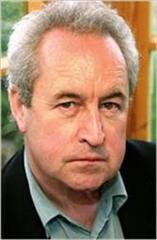
Benjamin Black
Irish novelist John Banville was born in Wexford in Ireland in 1945. He was educated at a Christian Brothers' school and St Peter's College in Wexford. He worked for Aer Lingus in Dublin, an opportunity that enabled him to travel widely. He was literary editor of the Irish Times between 1988 and 1999. Long Lankin, a collection of short stories, was published in 1970. It was followed by Nightspawn (1971) and Birchwood (1973), both novels.
Banville's fictional portrait of the 15th-century Polish astronomer Dr Copernicus (1976) won the James Tait Black Memorial Prize (for fiction) and was the first in a series of books exploring the lives of eminent scientists and scientific ideas. The second novel in the series was about the 16th-century German astronomer Kepler (1981) and won the Guardian Fiction Prize. The Newton Letter: An Interlude (1982), is the story of an academic writing a book about the mathematician Sir Isaac Newton. It was adapted as a film by Channel 4 Television. Mefisto (1986), explores the world of numbers in a reworking of Dr Faustus.
The Book of Evidence (1989), which won the Guinness Peat Aviation Book Award and was shortlisted for the Booker Prize for Fiction, Ghosts (1993) and Athena (1995) form a loose trilogy of novels narrated by Freddie Montgomery, a convicted murderer. The central character of Banville's 1997 novel, The Untouchable, Victor Maskell, is based on the art historian and spy Anthony Blunt. Eclipse (2000), is narrated by Alexander Cleave, an actor who has withdrawn to the house where he spent his childhood. Shroud (2002), continues the tale begun in Eclipse and Prague Pictures: Portrait of a City (2003), is a personal evocation of the magical European city.
John Banville lives in Dublin. The Sea (2005) won the 2005 Man Booker Prize. In The Sea an elderly art historian loses his wife to cancer and feels compelled to revisit the seaside villa where he spent childhood holidays. His latest novel is The Infinities (2009).
Who is Benjamin Black?
Benjamin Black is the pseudonym used by Irish novelist John Banville. The Booktopia page links Benjamin Black to Banville and refers readers to Banville's author page for his broader body of work.
What genres and themes does he write about?
Banville’s work (including that under the Benjamin Black name) spans literary novels and short stories. Recurring themes include portraits of scientists and scientific ideas, art and memory, moral ambiguity, and evocative settings such as Prague and seaside childhoods.
What are some notable books to look for?
Notable titles mentioned on the page include Long Lankin, Nightspawn, Birchwood, The Newton Letter: An Interlude, Mefisto, The Book of Evidence, Ghosts, Athena, The Untouchable, Eclipse, Shroud, Prague Pictures: Portrait of a City, The Sea and The Infinities.
Where should I start reading, is there a reading order for his series?
A good entry point is The Sea (2005), Banville’s Man Booker Prize winner, or The Book of Evidence (1989), the first of a loose trilogy. The Freddie Montgomery trilogy reads: The Book of Evidence, then Ghosts (1993), then Athena (1995). His sequence of novels about eminent scientists begins with his 1976 Copernicus novel, followed by the Kepler novel (1981) and The Newton Letter (1982).
What major awards has he received?
Highlights on the page include the James Tait Black Memorial Prize for his Copernicus novel, the Guardian Fiction Prize for the Kepler novel, the Guinness Peat Aviation Book Award (The Book of Evidence) with a Booker Prize shortlisting, and the 2005 Man Booker Prize for The Sea.