From a leading art historian, a provocative exploration of the intersection of art, politics, and historical memory in 1960s Italy.
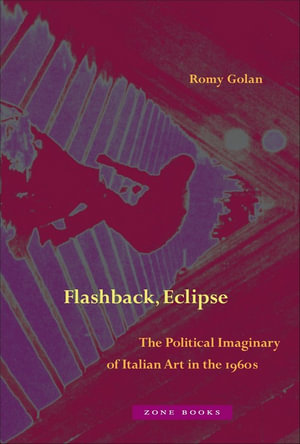
Flashback, Eclipse is a groundbreaking study of 1960s Italian art and its troubled but also resourceful relation to the history and politics of the first part of the twentieth century and the aftermath of World War II. Most analyses have generally treated the 1960s in Italy as the decade of "presentism" par excellence, a political decade but one liberated from history. Romy Golan, however, makes the counterargument that 1960s Italian artists did not forget Italian and European history but rather reimagined it in oblique form. Her book identifies and explores this imaginary through two forms of nonlinear and decidedly nonpresentist forms of temporality-the flashback and the eclipse. In view of the photographic and filmic nature of these two concepts, the book's analysis is largely mediated by black-and-white images culled from art, design, and architecture magazines, photo books, film stills, and exhibition documentation.
The book begins in Turin with Michelangelo Pistoletto's Mirror Paintings; moves on to Campo urbano, a one-day event in the city of Como; and ends with the Vitalita del Negativo exhibition in Rome. What is being recalled and at other moments occluded are not only episodes of Italian nationalism and Fascism but also various liberatory moments of political and cultural resistance. The book's main protagonists are, in order of appearance, artists Michelangelo Pistoletto and Giosetta Fioroni, photographer Ugo Mulas, Ettore Sottsass (as critic rather than designer), graphic designer Bruno Munari, curators Luciano Caramel and Achille Bonito Oliva, architect Piero Sartogo, Carla Lonzi (as artist as much as critic), filmmakers Michelangelo Antonioni and Bernardo Bertolucci, and, in flashback among the departed, painter Felice Casorati, writer Massimo Bontempelli, art historian Aby Warburg, architect Giuseppe Terragni, and Renaissance friar-philosopher-mathematician Giordano Bruno (as patron saint of the sixty-eighters).
Industry Reviews
"The book I was most excited for this year is Romy Golan's Flashback, Eclipse. . . . Golan uses archival imagery and the journalistic coverage of installations and performances to uncover histories that may have been hidden for non-Italians or for those not wholly versed in Italian postwar art. . . . Though she writes of art in Venice and Rome, her book also takes us outside of those centers to cities like Como and Torino, so evocative of the period and place that I pictured myself reading it while sipping a bicerin on the Piazza della Consolata."---Amanda Gluibizzi, Brooklyn Rail
"Golan weaves a complex and significant narrative about the ways in which Italy's past affected the art of the 1960s. Her book offers an important model by which other scholars might begin to look more critically at the ambiguities of the afterlives of fascism in Italy."---Katie M.J. Larson, CAA Reviews
"One could characterize Flashback, Eclipse as an immersion into the historical strata of images that constitute something like a social archive of Italian visual memory. An expert diver, Golan brings unexpected associations and resonances back to the surface, exposing the persistence of various historical pasts in what many had taken to be our perpetual present."---Tom McDonough, Texte zur Kunst
"Flashback, Eclipse stands out from other studies of postwar Italian art in its attention to disarticulation and disruption in the smooth flow of time, precisely as suggested by the two title terms and the author's rather brilliantly idiosyncratic choice to focus on Pistoletto's mirrors."---Karen Pinkus, Italian Culture








![The Art of the Lord of the Rings [60th Anniversary Edition] - J. R. R. Tolkien](https://www.booktopia.com.au/covers/200/9780008601416/6057/the-art-of-the-lord-of-the-rings-60th-anniversary-edition-.jpg)