Get Free Shipping on orders over $79
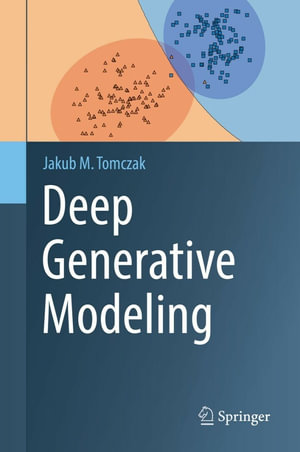
Deep Generative Modeling : Computer Science (R0) - Jakub M. Tomczak

Deep Generative Modeling

By: Jakub M. Tomczak

eText | 18 February 2022

At a Glance

eText


$84.99

or 4 interest-free payments of $21.25 with

 or 

Instant online reading in your Booktopia eTextbook Library *

Why choose an eTextbook?

Instant Access *

Purchase and read your book immediately

Read Aloud

Listen and follow along as Bookshelf reads to you

Study Tools

Built-in study tools like highlights and more

* eTextbooks are not downloadable to your eReader or an app and can be accessed via web browsers only. You must be connected to the internet and have no technical issues with your device or browser that could prevent the eTextbook from operating.

This textbook tackles the problem of formulating AI systems by combining probabilistic modeling and deep learning. Moreover, it goes beyond typical predictive modeling and brings together supervised learning and unsupervised learning. The resulting paradigm, called deep generative modeling, utilizes the generative perspective on perceiving the surrounding world. It assumes that each phenomenon is driven by an underlying generative process that defines a joint distribution over random variables and their stochastic interactions, i.e., how events occur and in what order. The adjective "deep" comes from the fact that the distribution is parameterized using deep neural networks. There are two distinct traits of deep generative modeling. First, the application of deep neural networks allows rich and flexible parameterization of distributions. Second, the principled manner of modeling stochastic dependencies using probability theory ensures rigorous formulation and prevents potential flaws in reasoning. Moreover, probability theory provides a unified framework where the likelihood function plays a crucial role in quantifying uncertainty and defining objective functions.

Deep Generative Modeling is designed to appeal to curious students, engineers, and researchers with a modest mathematical background in undergraduate calculus, linear algebra, probability theory, and the basics in machine learning, deep learning, and programming in Python and PyTorch (or other deep learning libraries). It will appeal to students and researchers from a variety of backgrounds, including computer science, engineering, data science, physics, and bioinformatics, who wish to become familiar with deep generative modeling. To engage the reader, the book introduces fundamental concepts with specific examples and code snippets. The full code accompanying the book is available on github.

The ultimate aim of the book is to outline the most important techniques in deep generative modeling and, eventually, enable readers to formulate new models and implement them.

on
Desktop
Tablet
Mobile

More in Artificial Intelligence

AI-Powered Search - Trey Grainger

eBOOK

HBR Guide to Generative AI for Managers : HBR Guide - Elisa Farri

eBOOK

AI : The End of Human Race - Alex Wood

eBOOK