




Instant online reading.
Don't wait for delivery!
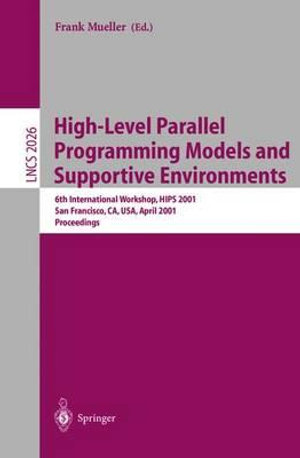
High-Level Parallel Programming Models and Supportive Environments
6th International Workshop, HIPS 2001 San Francisco, CA, USA, April 23, 2001 Proceedings
By: Frank Mueller (Editor)
Paperback | 4 April 2001
At a Glance
Paperback
$84.99
Ships in 5 to 7 business days
ISBN: 9783540419440
ISBN-10: 3540419446
Series: Lecture Notes in Computer Science
Published: 4th April 2001
Format: Paperback
Language: English
Number of Pages: 156
Audience: General Adult
Publisher: Springer Nature B.V.
Country of Publication: DE
Dimensions (cm): 24.77 x 15.88 x 1.27
Weight (kg): 0.23
Shipping
| Standard Shipping | Express Shipping | |
|---|---|---|
| Metro postcodes: | $9.99 | $14.95 |
| Regional postcodes: | $9.99 | $14.95 |
| Rural postcodes: | $9.99 | $14.95 |
Orders over $79.00 qualify for free shipping.
How to return your order
At Booktopia, we offer hassle-free returns in accordance with our returns policy. If you wish to return an item, please get in touch with Booktopia Customer Care.
Additional postage charges may be applicable.
Defective items
If there is a problem with any of the items received for your order then the Booktopia Customer Care team is ready to assist you.
For more info please visit our Help Centre.
You Can Find This Book In


RRP $152.00
$73.75
OFF
RRP $95.00
$47.75
OFF

RRP $106.75
$52.75
OFF

RRP $152.00
$73.75
OFF

RRP $106.75
$52.75
OFF


RRP $123.85
$81.75
OFF

RRP $152.00
$73.75
OFF


RRP $152.00
$60.00
OFF

RRP $152.00
$73.75
OFF

RRP $125.75
$60.99
OFF

RRP $133.00
$64.75
OFF

RRP $106.75
$52.75
OFF




RRP $145.20
$58.00
OFF
RRP $152.00
$60.00
OFF

RRP $114.00
$55.75
OFF
This product is categorised by
- Non-FictionComputing & I.T.Computer ScienceComputer Architecture & Logic DesignParallel Processing
- Non-FictionComputing & I.T.Computer Programming & Software DevelopmentSoftware Engineering
- Non-FictionComputing & I.T.Computer Networking & Communications
- Non-FictionComputing & I.T.Computer Programming & Software DevelopmentProgramming & Scripting Languages
- Non-FictionComputing & I.T.Operating Systems
- Non-FictionComputing & I.T.Computer HardwareNetwork Hardware