Get Free Shipping on orders over $79
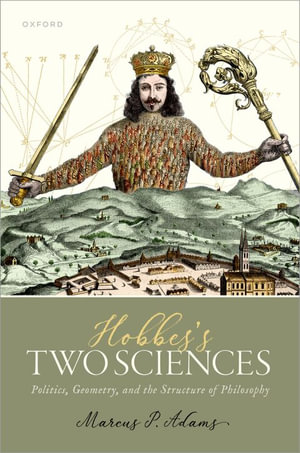
Hobbes's Two Sciences : Politics, Geometry, and the Structure of Philosophy - Marcus P. Adams

Hobbes's Two Sciences

Politics, Geometry, and the Structure of Philosophy

By: Marcus P. Adams

eText | 18 January 2025 | Edition Number 1

At a Glance

eText


$118.56

or 4 interest-free payments of $29.64 with

 or 

Instant online reading in your Booktopia eTextbook Library *

Why choose an eTextbook?

Instant Access *

Purchase and read your book immediately

Read Aloud

Listen and follow along as Bookshelf reads to you

Study Tools

Built-in study tools like highlights and more

* eTextbooks are not downloadable to your eReader or an app and can be accessed via web browsers only. You must be connected to the internet and have no technical issues with your device or browser that could prevent the eTextbook from operating.

Seventeenth-Century Thinker Thomas Hobbes maintained that his philosophy constituted a unified system, but in what precise sense did he think that the branches of his philosophy were unified? This question has provoked extensive scholarship over the last half-century. Answering it is essential not only to understanding Hobbes's philosophy generally, but how one answers it significantly impacts our understanding of the Leviathan, his most influential work, and of the Laws of Nature, the foundation of his political philosophy. Hobbes's Two Sciences answers the question of philosophical unificiation by situating Hobbes's politics within his account of scientific knowledge as constructed by humans—an epistemology founded on the idea that makers have special access to causal knowledge—and by demonstrating that the relationship between pure and mixed mathematics provided him with a model for thinking about relationships between geometry and natural philosophy and between politics and history. Marcus P. Adams explores how this understanding of Hobbes's systematic philosophy impacts three long-standing areas of scholarship on Hobbes and the History of Early Modern Philosophy and provides a new view on Hobbes's system .

on
Desktop
Tablet
Mobile

More in History of Western Philosophy

Story of Philosophy - Will Durant

eBOOK