Get Free Shipping on orders over $79
Knowledge-augmented Methods for Natural Language Processing : SpringerBriefs in Computer Science - Meng Jiang

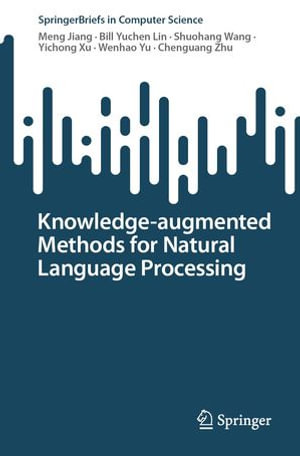
Knowledge-augmented Methods for Natural Language Processing

By: Meng Jiang, Bill Yuchen Lin, Shuohang Wang, Yichong Xu, Chenguang Zhu

eText | 8 April 2024

At a Glance

eText


$74.99

or 4 interest-free payments of $18.75 with

 or 

Instant online reading in your Booktopia eTextbook Library *

Why choose an eTextbook?

Instant Access *

Purchase and read your book immediately

Read Aloud

Listen and follow along as Bookshelf reads to you

Study Tools

Built-in study tools like highlights and more

* eTextbooks are not downloadable to your eReader or an app and can be accessed via web browsers only. You must be connected to the internet and have no technical issues with your device or browser that could prevent the eTextbook from operating.

Over the last few years, natural language processing has seen remarkable progress due to the emergence of larger-scale models, better training techniques, and greater availability of data. Examples of these advancements include GPT-4, ChatGPT, and other pre-trained language models. These models are capable of characterizing linguistic patterns and generating context-aware representations, resulting in high-quality output. However, these models rely solely on input-output pairs during training and, therefore, struggle to incorporate external world knowledge, such as named entities, their relations, common sense, and domain-specific content. Incorporating knowledge into the training and inference of language models is critical to their ability to represent language accurately. Additionally, knowledge is essential in achieving higher levels of intelligence that cannot be attained through statistical learning of input text patterns alone. In this book, we will review recent developmentsin the field of natural language processing, specifically focusing on the role of knowledge in language representation. We will examine how pre-trained language models like GPT-4 and ChatGPT are limited in their ability to capture external world knowledge and explore various approaches to incorporate knowledge into language models. Additionally, we will discuss the significance of knowledge in enabling higher levels of intelligence that go beyond statistical learning on input text patterns. Overall, this survey aims to provide insights into the importance of knowledge in natural language processing and highlight recent advances in this field.

on
Desktop
Tablet
Mobile

More in Data Mining

Investing for Programmers - Stefan Papp

eBOOK

Conquering the Decision Abyss - Keith Hartley

eBOOK

RRP $15.39

$14.99

Discrete and Computational Geometry, 2nd Edition - Satyan L. Devadoss

eBOOK

Data Analysis with LLMs - Immanuel Trummer

eBOOK

Big Data Analytics - Nitin Kumar Yadav

eBOOK