



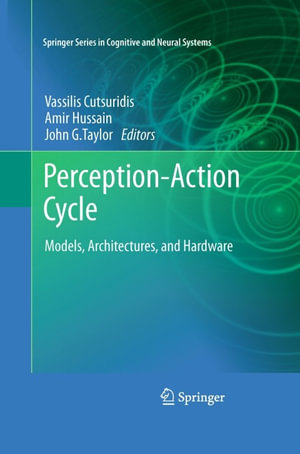
Perception-Action Cycle
Models, Architectures, and Hardware
By: Vassilis Cutsuridis, ?Amir Hussain, ?John G. Taylor
eText | 2 February 2011 | Edition Number 1
At a Glance
eText
$529.00
or
Instant online reading in your Booktopia eTextbook Library *
Why choose an eTextbook?
Instant Access *
Purchase and read your book immediately
Read Aloud
Listen and follow along as Bookshelf reads to you
Study Tools
Built-in study tools like highlights and more
* eTextbooks are not downloadable to your eReader or an app and can be accessed via web browsers only. You must be connected to the internet and have no technical issues with your device or browser that could prevent the eTextbook from operating.
ISBN: 9781441914521
ISBN-10: 1441914528
Series: Springer Series in Cognitive and Neural Systems
Published: 2nd February 2011
Format: ePUB
Language: English
Publisher: Springer Nature
Edition Number: 1
You Can Find This eBook In
Non-FictionBusiness & ManagementBusiness Mathematics & SystemsComputing & I.T.Computer Programming & Software DevelopmentAlgorithms & Data StructuresMedicineClinical & Internal MedicineNeurology & Clinical NeurophysiologyScienceBiology, Life SciencesZoology & Animal Sciences
Engineering & TechnologyElectronics & Communications EngineeringElectronics EngineeringLife Sciences in GeneralNeurosciencesOther Technologies & Applied SciencesApplied OpticsImaging Systems & TechnologyComputer ScienceImage ProcessingMathematical Theory of ComputationDigital Signal Processing (DSP)Mathematics














This product is categorised by
- Non-FictionBusiness & ManagementBusiness Mathematics & Systems
- Non-FictionComputing & I.T.Computer Programming & Software DevelopmentAlgorithms & Data Structures
- Non-FictionMedicineClinical & Internal MedicineNeurology & Clinical Neurophysiology
- Non-FictionScienceBiology, Life SciencesZoology & Animal Sciences
- Non-FictionEngineering & TechnologyElectronics & Communications EngineeringElectronics Engineering
- Non-FictionScienceBiology, Life SciencesLife Sciences in GeneralNeurosciences
- Non-FictionEngineering & TechnologyOther Technologies & Applied SciencesApplied OpticsImaging Systems & Technology
- Non-FictionComputing & I.T.Computer ScienceImage Processing
- Non-FictionComputing & I.T.Computer ScienceMathematical Theory of Computation
- Non-FictionComputing & I.T.Computer ScienceDigital Signal Processing (DSP)
- Non-FictionMathematics